12 Questions to Ask Every Deck Contractor Before You Sign a Contract
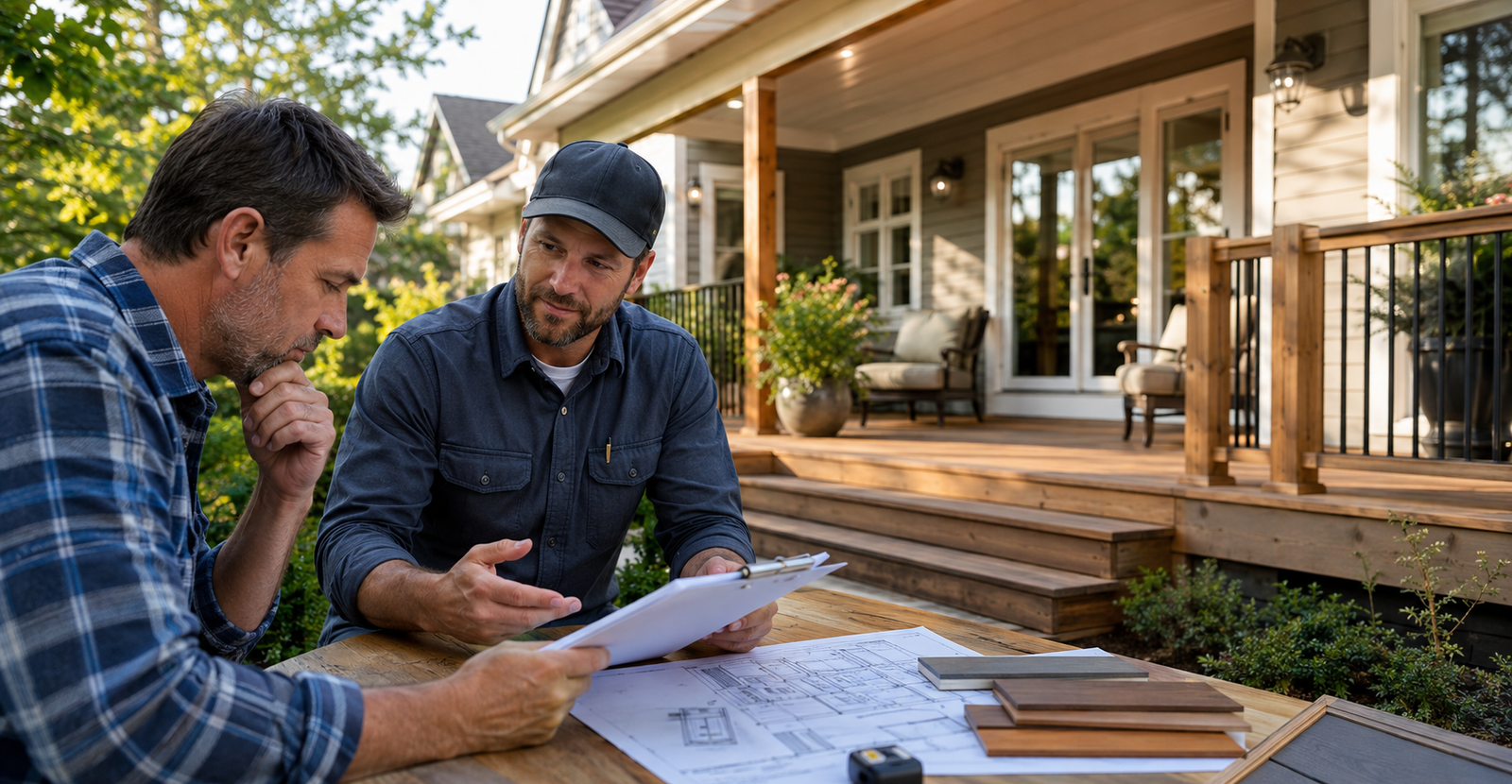
12 Questions to Ask Every Deck Contractor Before You Sign a Contract
Hiring a deck contractor can feel straightforward at first. You find someone who builds decks, ask for a price, and choose the estimate that seems reasonable.
Unfortunately, that approach can lead to costly problems.
A deck is not just a cosmetic addition to your home. It must support weight, withstand weather, meet local building codes, and remain safe for years. A poorly built deck can develop loose railings, uneven boards, water damage, structural problems, or permit issues that become your responsibility.
Before signing a contract, ask every contractor the following questions. Their answers will help you compare bids, uncover hidden costs, and avoid hiring someone who is not prepared to handle the job properly.
1. Are You Licensed and Insured?
This should be one of your first questions.
Ask the contractor to provide their license number and verify it with your state licensing agency. The license should be active and appropriate for the type of work being performed.
You should also ask for proof of general liability insurance and workers’ compensation coverage. Liability insurance helps protect your property if the contractor causes damage. Workers’ compensation may protect you from being held responsible if a worker is injured on your property.
Do not rely on a verbal assurance. Ask to see current documentation.
2. How Much Experience Do You Have Building Decks?
A contractor may have years of general construction experience without having much experience building decks.
Deck construction involves specific knowledge of footings, framing, flashing, drainage, fasteners, railing systems, and load requirements. Ask how many decks the company builds each year and whether they regularly work with the material you are considering.
A contractor who mainly remodels kitchens may not be the best choice for a complicated elevated deck.
3. Can I See Recent Examples of Your Work?
Photos can tell you a great deal about a contractor’s attention to detail.
Ask to see completed projects that are similar in size, style, and material to the deck you want. Look closely at stair placement, railing alignment, board spacing, transitions, and how the deck connects to the house.
When possible, ask for addresses of completed projects that can be viewed from the street. Some contractors may also be able to arrange a visit with a past customer.
Recent work is more useful than a portfolio filled with projects from many years ago.
4. Can You Provide References From Recent Customers?
Ask for at least two or three references from homeowners whose projects were completed within the last year.
When speaking with a former customer, ask whether the contractor arrived when promised, kept the jobsite clean, communicated clearly, handled changes fairly, and finished close to the original budget.
Also ask whether any problems appeared after completion and how the contractor responded.
A good contractor should be comfortable connecting you with satisfied customers.
5. Who Will Actually Perform the Work?
The person who gives you the estimate may not be the person who builds your deck.
Ask whether the contractor uses employees, subcontractors, or a combination of both. Find out who will supervise the project and who you should contact with questions.
There is nothing automatically wrong with using subcontractors, but you should know who is responsible for the work. The main contractor should remain accountable for scheduling, quality, permits, inspections, and corrections.
6. Who Is Responsible for Permits and Inspections?
Most structural deck projects require a building permit, although the rules vary by location.
Ask the contractor whether a permit is required and who will obtain it. In most cases, the contractor should handle the permit and schedule the required inspections.
Be cautious if someone tells you that a permit is unnecessary without checking local requirements. Also be wary of any contractor who asks you to pull the permit in your own name. That may shift responsibility for code compliance onto you.
The contract should clearly state who is responsible for permit fees and inspections.
7. What Materials Are Included in the Price?
A quote that says “composite deck” is not specific enough.
Ask for the exact brand, product line, color, board type, railing system, fasteners, framing materials, and hardware included in the price. Composite and PVC decking products vary widely in quality and cost.
The same applies to pressure-treated wood, cedar, redwood, and tropical hardwoods. The grade and condition of the lumber matter.
Detailed material specifications make it easier to compare estimates and prevent substitutions later.
8. How Will You Protect the Deck From Water Damage?
Water is one of the biggest threats to a deck.
Ask how the contractor will install flashing where the deck connects to the house. Proper flashing helps prevent water from entering behind the siding or damaging the house framing.
You should also ask about joist protection tape, drainage around footings, board spacing, and ventilation beneath the deck.
A contractor who understands moisture control should be able to explain these details clearly.
9. What Is Not Included in the Estimate?
This question can prevent unpleasant surprises.
The quoted price may not include demolition, hauling, permit fees, engineering, painting, staining, landscaping repairs, electrical work, lighting, or removal of unexpected obstacles.
Ask the contractor to list all exclusions in writing.
You should also ask what happens if workers uncover rot, poor soil conditions, damaged framing, buried utilities, or other problems after construction begins.
10. How Do You Handle Changes and Additional Costs?
Changes are common during construction, but they should not be handled casually.
Ask how the contractor prices change orders and whether you will receive a written description and price before extra work begins.
Never depend on informal conversations at the jobsite. A written change order should explain what is changing, how much it will cost, and whether it will affect the schedule.
This protects both you and the contractor.
11. What Is the Payment Schedule?
Avoid contractors who demand the full price upfront.
A reasonable payment schedule usually includes an initial deposit followed by payments tied to specific stages of the project. These stages might include permit approval, material delivery, framing completion, and final inspection.
The final payment should not be due until the project is complete, required inspections have passed, and agreed-upon corrections have been made.
Make sure the contract states the exact payment amounts and when each payment is due.
12. What Warranty Do You Provide?
Ask about both the contractor’s workmanship warranty and the manufacturer’s material warranty.
The workmanship warranty should explain how long the contractor will cover installation problems and what is included. Material warranties may cover fading, staining, cracking, or structural defects, depending on the product.
Find out who handles warranty claims and whether the manufacturer requires the deck to be installed in a specific way.
Get all warranty terms in writing.
Take Your Time Before Signing
A professional deck contractor should not become irritated when you ask detailed questions. Good contractors expect homeowners to compare estimates and review the project carefully.
Do not choose a contractor based on price alone. A low bid may leave out permits, proper flashing, quality materials, insurance, or important structural details.
Before signing, read the entire contract and make sure it includes the scope of work, materials, payment schedule, estimated start and completion dates, cleanup responsibilities, warranties, and procedures for changes.
A few extra questions before construction begins can save you from months of frustration and thousands of dollars in repairs later.